To me, religion/religious belief involves spirituality but spirituality does not necessitate religious belief. I regard spirituality as an endeavor to establish a meaningful connection between oneself and their surroundings. As abstract and ambiguous as that statement is, it really means that spirituality is an individual’s attempt to make meaning and add greater clarity in their lives (Mayhew, 2004). I suppose that statement is not any less ambiguous, but it adds some coherence to a term I grapple with because of its abstract and subjective nature. The power of spirituality rests in the fact that it does not have to look or be enacted in a certain way. Mayhew’s (2004) perspective and definition of spirituality was enlightening. Mayhew (2004) offered a way to qualify a term I still struggle to qualify. I like the concept of spirituality but I don’t know if I’m committed to it.
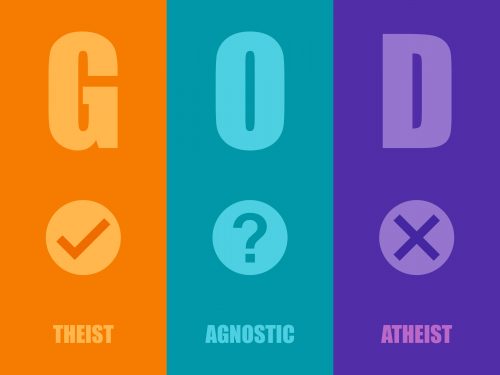
Throughout my undergraduate years I started to question what relevance religious belief had in my life, or if I even believed in God. Eventually I decided that while I do not think God or gods exist, who am I dictate absolute truth? Because, you know, I’m not God nor do I possess any all-knowing powers. I respect the fact that some people find empowerment and solace in religious belief and spiritual practices, and I hope they can respect the fact that I don’t.
While Smith’s (2011) proposed model of identity development for self-identified atheists does not fully capture my own development with theism, especially since I do not self-identify as an atheist, it is a suitable lens to view my own experience. The stages Smith (2011) identifies are:
- The starting point, the ubiquity of theism: individuals espouse belief in God and have certainty of God’s existence
- Questioning theism: Individuals begin questioning theism when they interact in different settings and contexts
- Rejecting theism: Individuals transition from exploration and questioning to actively rejecting the idea of God and religion
- “Coming out” atheist: Characterized by full self-acceptance of an atheist identity. Individuals are progressively able to express what it means for them to be atheist, internally and externally
Stage two adequately captures how I felt as an undergraduate. I can’t say there was one particular person or persons who compelled me to question my previously held theistic beliefs. Perhaps it was sharing a dorm with someone who was very devout, which made me realize I didn’t share any of her beliefs. Or perhaps it was meeting diverse others. Or no longer being tethered to an obligation to go to church. It isn’t eloquent or insightful to say “it just happened” but it did happen in a relatively passive way. Today, I exist somewhere between the third and fourth stages. While I reject theism, I haven’t fully “come out” to certain members of my family, specifically my grandmother. She is extremely devout and I don’t know how she would react to me announcing that I’m agnostic. She knows I don’t “do church,” but putting a label on it, and one that is such an “affront” to everything she stands for and believes, isn’t somewhere I need to go. My mother, though, who is a proud Episcopalian, was accepting. We agree on a lot and I think it’s perfectly acceptable that we disagree about God.
References:
Mayhew, M. J. (2004). Exploring the essence of spirituality: A phenomenological study of eight students with eight different worldviews. NASPA Journal, 41, 647-675. doi:10.2202/1949-6605.1392
Smith, J. M. (2011). Becoming an atheist in America: Constructing identity and meaning from the rejection of theism. Sociology of Religion, 72, 215-237.
 Neon Notions
Leave a comment