
Bronfenbrenner’s Ecological Systems Theory
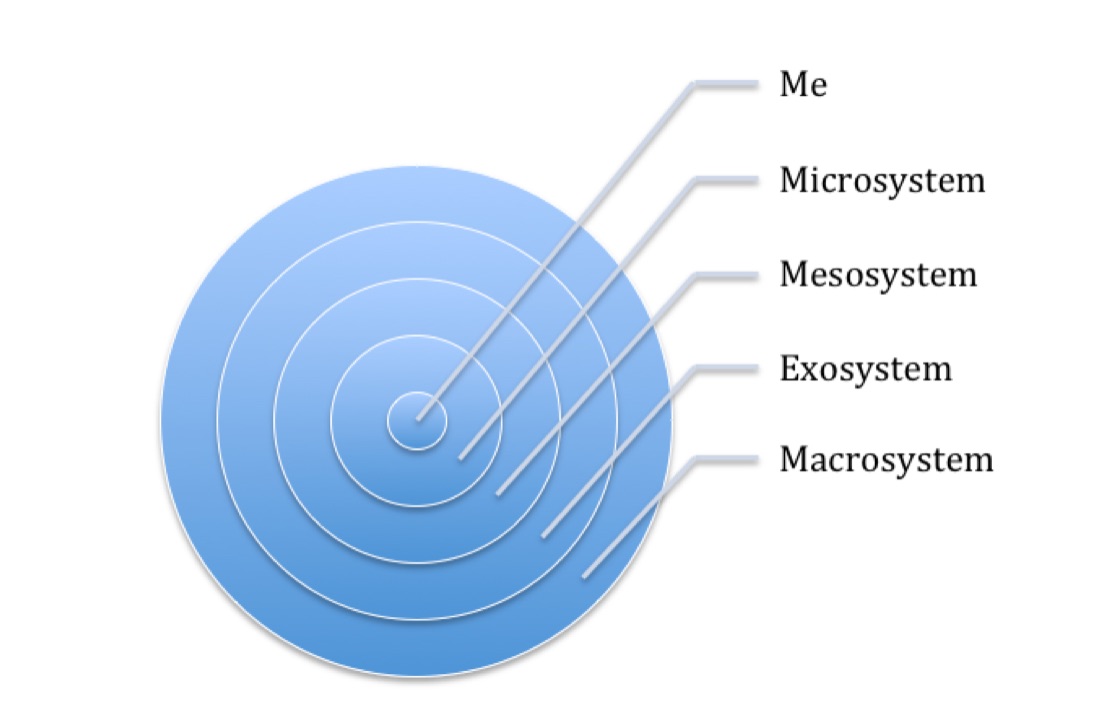
Environmental contexts are important to consider when reflecting on your own development as a college student. There are five levels that affect a person’s development: microsystems, mesosystems, exosystems, macrosystems, and chronosystems (Bronfenbrenner, 1977, 1986, 1994, 2005). For the purpose of this entry, I will focus on the first four levels. According to Barber, Espino, and Bureau (2015), “these levels demonstrate the interrelated effect of social context and process on individuals over time” (p. 248).
The individual is situated at the center of the model and is surrounded by microsystems, which is the relationship between an individual and their environment within a particular setting. As an undergraduate I considered my microsystem to be comprised of family and friends, the departments of history and women’s, gender, and sexuality studies at the University of Oregon, Residence Life colleagues, and the staff at Ophelia’s Place. These constituencies represented my closest relationships as an undergraduate and my immediate environment. Now, as a graduate student, I retain family and friends in my microsystem, but I consider the School of Education, the Career Center, and those with whom I work on committees and digital publications to be new additions to my microsystem. The next level is the mesosystem, which represents the relationships between the settings within my microsystem, and are best embodied in University of Oregon Residence Life or the city of Eugene. As a graduate student, I see the Division of Student Affairs as a central component of my mesosystem. The third level is the exosystem, which is an extension of the mesosystem and includes events and processes that indirectly affect the student, such as changes in state/federal law (Barber, Espino, & Bureau, 2015). Both as an undergraduate and graduate student I see the declining financial state support, which affects issues of tuition and financial aid for all students, as a recurring element of my exosystem. Finally, “the macrosystem describes the attitudes or ideologies of a culture in which an individual lives” (Barber et al., 2015, p. 248), such as campus culture. As an undergraduate and graduate student, a welcoming campus culture, at least for me, has been essential in the development of my microsystem and continues to shape my experiences as a student. For me, notable elements of a welcoming campus culture include friendly students/faculty/staff, diverse events/activities, and plentiful resources that promote academic, personal, professional, and social enrichment.
References:
Barber, J. P., Espino, M. M., & Bureau, D. A. (2015). Fraternities and sororities: Developing a compelling case for relevance in higher education. In P. Sasso and J. DeVitis (Eds.), Today’s College Student (pp. 241-255). New York, NY: Peter Lang Press.
Bronfenbrenner, U. (1977). Toward an experimental ecology of human development. American Psychologist, 32(7), 513-531. doi:10. 1037/0003-066X.32.7.513
Bronfenbrenner, U. (1986). Ecology of the family as a context for human development: Research perspectives. Developmental Psychology, 22(6), 723-742. doi:10.1037//0012-1649.22.6.723
Bronfenbrenner, U. (1994). Ecological models of human development. In International encyclopedia of education (2nd ed., Vol. 3, pp. 1643-1647). Oxford, UK: Elsevier.
Bronfenbrenner, U. (2005). Making human beings human: Bioecological perspectives on human development. Thousand Oaks, CA: Sage.
 Neon Notions
Leave a comment